On this page
Teaching Young Players to Scan Before Receiving the Ball
For parents exploring scanning before receiving football, here's what our Pitch Ready coaches suggest. You can see how we build this up in our first-touch coaching.
One of the most crucial skills in modern football, often overlooked in early development, is "scanning" – knowing what's around you before the ball arrives. It’s the difference between a player who reacts slowly under pressure and one who seems to have all the time in the world. As coaches and parents, we want our young players in Enfield and the surrounding areas to develop this proactive approach from an early age.
Why Scanning Matters So Much
Think about the best players in the game. They rarely dribble into trouble or misplace a simple pass. A huge part of this is their awareness. They've already processed information about defenders, teammates, and open space before the ball reaches their feet. This pre-scan allows them to make quicker, more effective decisions.
For young players, who often focus solely on the ball, scanning takes conscious effort to learn. Without it, they're often surprised by an approaching defender or miss an obvious open pass. It stunts their decision-making and limits their overall impact on the game.
Practical Drills for Developing Awareness
We don't need highly complex drills to teach scanning. It's about building habits and making players comfortable looking up.
The "Head-Up" Catch
This is a simple, non-football specific drill to start with.
- Setup: Two players, 5-10 yards apart, with a tennis ball or soft football.
- How it works: Player A throws the ball to Player B. As the ball travels through the air, Player B must quickly look over one shoulder, then the other, before catching the ball.
- Coach's cue: "Scan, scan, catch!" or "Eyes up before the ball!"
- Progression: Introduce a verbal cue from Player A. For example, Player A shouts "Left!" or "Right!" before throwing, and Player B must confirm by looking in that direction before catching.
Cone Colour Recognition
Adding an external cue encourages players to lift their heads.
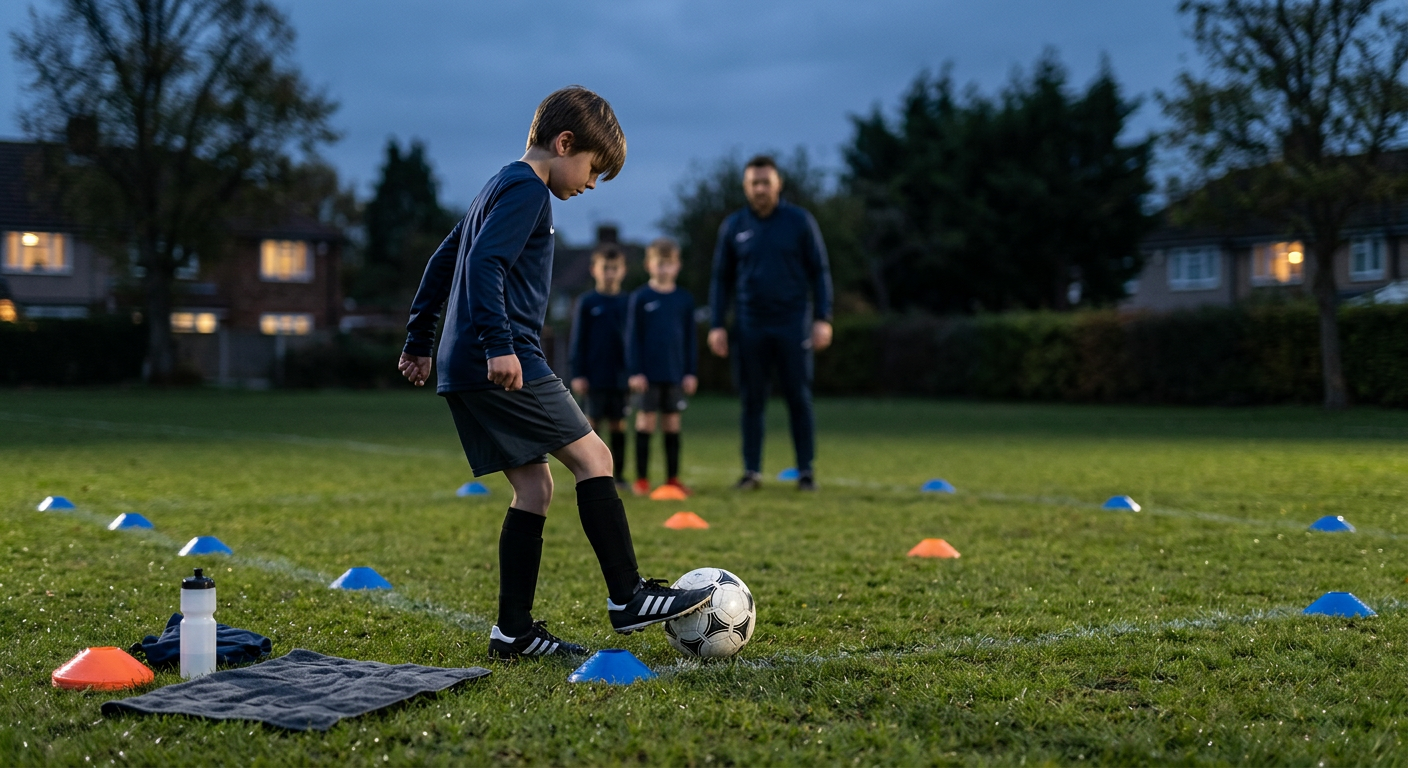
- Setup: A player stands in the middle of a small square (5x5 yards). Place four different coloured cones (e.g., red, blue, yellow, green) at each corner of the square. A coach or parent stands outside the square with a ball.
- How it works: The coach rolls or passes the ball to the player. As the ball is travelling, the coach shouts out a cone colour. The player must quickly look at that cone, then receive the ball, and then pass it back or dribble to that cone.
- Focus: The key is to look at the cone before the ball arrives.
"Pass and Look" with Decision
This drill brings the concept closer to a game situation.
- Setup: Three players (or two players and a wall/rebounder if indoors) in a small triangular or rectangular area. Two players (A and B) are separated by about 10-15 yards, with a third player (C) off to the side, maybe 5-7 yards from player B. Coach stands near Player A.
- How it works:
1. Coach passes to Player A. 2. Player A passes the ball to Player B. 3. Crucially, as the ball travels from A to B, Player B must quickly look over their shoulders to see if Player C is free or marked. 4. Player B then receives the ball and makes a decision: pass to C if free, or pass back to A if C is marked.
- Variations: Player C can be a passive defender, a static target, or even a cone that represents a space to play into. The key is for Player B to scan for information in that split second.
Coaching Cues and Reinforcement
Consistent communication is vital. Use short, sharp prompts:
- "Head up!"
- "Picture!" (meaning, create a mental picture of what's around you)
- "Check your shoulders!"
- "Where's the space?"
- "Who's around you?"
Praise excellent scanning, even if the subsequent pass isn't perfect. We're training the habit first. Remind players that looking up isn't just about spotting defenders; it's also about seeing open space and teammates making runs. This builds better game intelligence and decision-making over time, a core component of our coaching philosophy at Pitch Ready Football.
By consistently incorporating these simple ideas into training sessions, whether in a focused 1-to-1 session in Grange Park or a small group setting in Winchmore Hill, we can help young footballers develop a truly advanced skill that will benefit them immensely as they progress in the game.
If you’d like to see how we can specifically tailor these techniques for your child, why not book an evaluation session with us?
Frequently asked questions
Written by
Founder and head coach at Pitch Ready Football. Alejandro runs one-to-one and small-group youth coaching sessions across North London, focused on ball mastery, confidence, and long-term development for children of all abilities.